Blocking Designs
Blocking accounts for known nuisance variation while preserving fair treatment comparisons. This page covers complete blocks, balanced incomplete blocks, and Latin squares. Numerical examples use illustrative practice data.
At a Glance
Each block contains every treatment. Treatment comparisons are made within blocks.
Each block contains only some treatments. Connectivity and balance determine which comparisons are estimable and how precise they are.
Randomized Complete Block Designs
Use a randomized complete block design (RCBD) when a known nuisance variable creates meaningful groups of similar units, and every treatment fits within every block.
Examples: compare production settings within each batch, or compare several conditions within each participant. Randomize within blocks, not across the whole experiment after forming them.
For treatments and blocks, with one observation per treatment-block cell,
| Parameter | Meaning | Estimate in this balanced design |
|---|---|---|
| Overall mean | ||
| Treatment deviation | ||
| Block deviation |
This is an additive model. With only one observation per cell, treatment-by-block interaction cannot be separated from random error. The simple analysis assumes interaction is negligible. Repeated measurements can also require a covariance model beyond these independent errors.
Block ANOVA
| Source | df | MS | Test |
|---|---|---|---|
| Treatment | |||
| Block | |||
| Error | |||
| Total |
For ,
A fixed-block test uses under . The scientific focus is usually the treatment comparison. Blocking should be planned from knowledge of the experiment, not selected solely through a block -value.
A treatment contrast uses
with the block-model residual df. For two treatments, the treatment test equals the squared paired statistic.
The mean-difference estimates and simple orthogonal SS formulas above rely on the complete balanced layout. Missing cells or unequal replication require fitting the appropriate linear model; marginal mean subtraction is not generally enough.
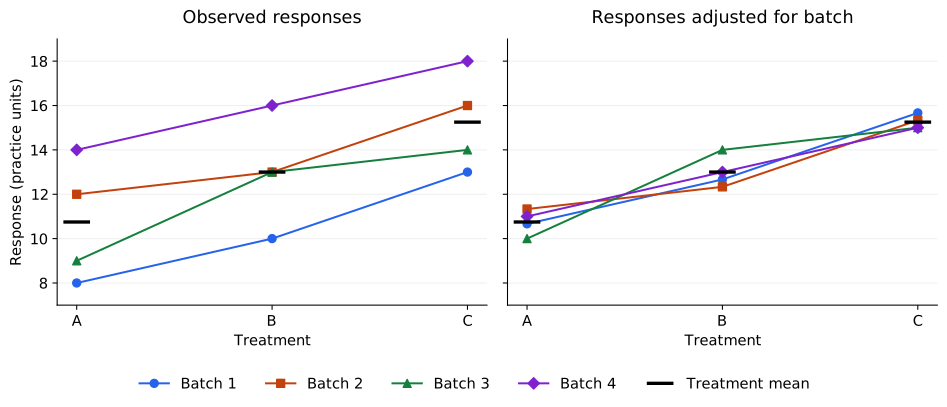
The right panel subtracts each estimated batch effect: . The treatment means stay the same in this balanced design, while the spread around each treatment mean shrinks. These adjusted responses illustrate the model; uncertainty still uses the block-model MSE and residual degrees of freedom.
Balanced Incomplete Block Designs
When each block can hold only treatments, a balanced incomplete block design (BIBD) spreads comparisons evenly.
| Symbol | Meaning |
|---|---|
| Number of treatments. | |
| Number of blocks. | |
| Treatments per block, each occurring once in that block. | |
| Blocks containing each treatment. | |
| Blocks containing each pair of distinct treatments. |
Counting all assignments and treatment co-occurrences gives
These are necessary conditions, not a guarantee that a design exists for arbitrary parameters. Under the usual additive model, balance makes treatment pair comparisons equally precise.
An incomplete block is incomplete by design, not a convenient description for uncontrolled missing observations. Allocate treatments and run order randomly within the design’s restrictions.
Latin Squares: Two Nuisance Factors
A Latin square assigns treatments across two nuisance factors, each with levels. Every treatment appears once in each row and once in each column.
| Column 1 | Column 2 | Column 3 | Column 4 | |
|---|---|---|---|---|
| Row 1 | A | B | C | D |
| Row 2 | B | C | D | A |
| Row 3 | C | D | A | B |
| Row 4 | D | A | B | C |
Rows might be days and columns time windows. A letter tells us which treatment to apply at that row-column combination. There are runs, rather than all row-column-treatment combinations.
Randomly permute row assignments, column assignments, and treatment labels within an appropriate Latin-square randomization scheme. The displayed square is a layout template, not a substitute for randomization.
Let identify the treatment in cell :
Under the balanced additive model, row, column, and treatment effects have sum-to-zero constraints. With the mean of the observations receiving treatment ,
| Source | df | Treatment test |
|---|---|---|
| Rows | ||
| Columns | ||
| Treatment | ||
| Error | ||
| Total |
Under the treatment null, under independent normal common-variance errors and additivity. For the square, error df is 6. A square has zero error df and cannot supply this error estimate.
The basic design cannot separately estimate general row-column, row-treatment, and column-treatment interactions. Strong interactions can invalidate the additive analysis.
Choosing the Analysis
| Design or question | Analysis | Essential check |
|---|---|---|
| Two independent quantitative groups | Pooled or Welch | Independent units; appropriate variance model. |
| Two matched conditions | Paired or within-pair randomization | Genuine pairing and independent pairs. |
| Several independent means | One-way ANOVA | Common variance and residual assumptions. |
| Specific mean combination | Contrast in the fitted model | Coefficients, SE, residual df, and testing family. |
| All pairwise mean differences | Tukey or another planned family procedure | Simultaneous rather than individual inference. |
| One nuisance factor; every treatment per block | RCBD | Randomization within blocks and additivity. |
| One nuisance factor; limited block capacity | Incomplete-block model | Connectivity, balance, and block-adjusted comparisons. |
| Two suitable nuisance factors | Latin square | One occurrence per row/column and negligible interactions. |