Saturated Designs & Foldovers
A very small screening experiment can examine many factors, but its estimates may mix main effects with interactions. A foldover adds deliberately chosen runs to change those alias relationships.
The useful question is not simply “How many more runs?” It is which unresolved effects should the new runs distinguish?
What Does Saturated Mean?
A model is saturated when the number of independent fitted parameters equals the number of observations. It leaves no residual degrees of freedom.
For a main-effects model in two-level factors, there are coefficients including the intercept. A regular two-level screening design needs at least
runs to estimate those coefficients without main-effect aliasing. When , the main-effects fit is saturated.
| Factors | Smallest power-of-two run count at least | Main-effects residual df |
|---|---|---|
| 3 | 4 | 0 |
| 4 | 8 | 3 |
| 5 | 8 | 2 |
| 7 | 8 | 0 |
| 8 | 16 | 7 |
This is a parameter-count requirement, not a promise of desirable resolution. Any residual df can contain omitted interactions when there is no genuine replication.
The maximum-factor regular orthogonal main-effects screening designs considered here have factors in runs and resolution III. “Saturated” more generally is a model-rank statement; it does not universally imply resolution III for every design or fitted model.
Seven Factors in Eight Runs
Start with the full three-column A, B, C sign table. Assign the other four factors to its remaining product columns:
The intercept plus A-G occupy all eight orthogonal columns. This is a regular fraction with defining generators
The complete defining group contains 16 words, including I. Its shortest nonidentity words have length 3.
| Fitted main-effect column | Two-way terms in the same alias class |
|---|---|
| A | BD, CE, FG |
| B | AD, CF, EG |
| C | AE, BF, DG |
| D | AB, CG, EF |
| E | AC, BG, DF |
| F | AG, BC, DE |
| G | AF, BE, CD |
Each class also contains higher-order effects. For example,
Do not report ordinary residual-based tests from this saturated fit. Its residuals are zero by construction. Large contrasts may guide follow-up, but neither a ranking nor a perfect fit supplies an error estimate.
Single-Factor Foldover
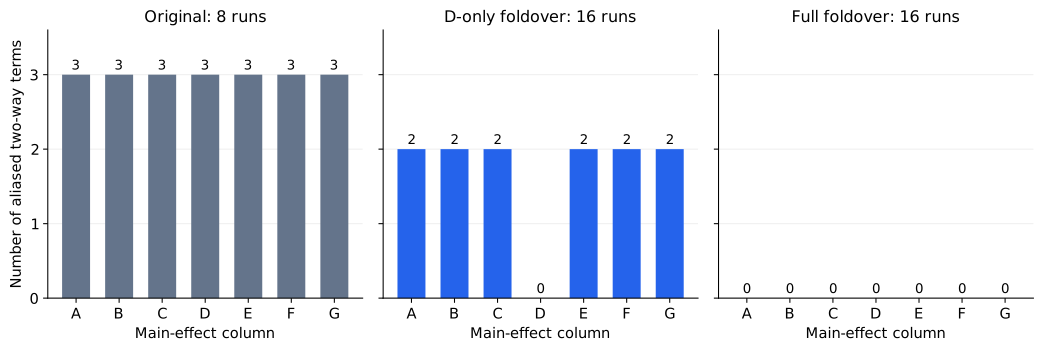
Suppose D is the priority. Add eight runs obtained by flipping only D in every original row, leaving the other six factor settings unchanged.
| Original fraction | Added fraction |
|---|---|
A defining word containing D changes sign between the two fractions. Words without D retain their signs. In the combined design, the surviving defining words do not contain D.
For this design, D and each D-containing two-way interaction become clear of other main effects and two-way interactions. Higher-order aliases still exist; the entire experiment has not become an unaliased full factorial.
How the New Information Appears
Ignoring higher-order terms only for this explanatory calculation,
The contrast of the A-column estimates isolates BD from the other displayed low-order terms. It does not isolate A from CE and FG.
Full Sign-Reversal Foldover
A full foldover reverses every actual factor setting: replace each row by .
A word of length changes by a factor . Thus:
Odd-length defining words change sign and no longer define the combined design.
Even-length defining words keep their sign and remain.
The seven-factor example therefore loses its length-3 words while retaining seven length-4 words:
The combined 16-run design has resolution IV. Main effects are clear of two-way interactions, but some two-way interactions remain aliased with one another and main effects remain aliased with higher-order terms.
Reverse Settings, Not Every Generator Formula
For the seven-factor design, expressing the reversed rows in terms of their new base-factor values gives
The G generator remains positive. Reversing all factors is not equivalent to blindly negating every dependent-factor formula: a three-factor product itself changes sign, while a two-factor product does not.
This distinction matters when writing code to construct follow-up runs. The simplest implementation is to negate every actual column of the original run table.
What Resolution Can a Foldover Achieve?
Removing all odd defining words eliminates resolution-III aliases and yields resolution at least IV, or a full factorial if no nonidentity words remain. It need not give exactly IV in every case.
A full sign reversal cannot remove length-4 defining words, so it does not turn a resolution-IV design into resolution V. If all defining words are even, the reversed treatment rows may already be in the original fraction: extra runs then replicate that fraction rather than resolve its structural aliases.
A targeted augmentation may distinguish an important pair of interactions more efficiently than a generic foldover. Check the combined model matrix and alias sets for the specific effects of interest.
Choosing a Follow-Up
| Objective | Useful strategy | Remaining limitation |
|---|---|---|
| Learn about D and its two-way interactions | D-only foldover in the illustrated design. | Other main-effect/two-way alias conflicts remain. |
| Separate all main effects from two-way terms | Full sign reversal of a resolution-III design. | Two-way terms may still be aliased with one another. |
| Separate a particular interaction pair | Choose runs that distinguish their columns. | Must verify the full proposed model is estimable. |
| Estimate experimental noise | Independently replicate appropriate settings. | Replication alone does not necessarily remove aliases. |
Treat the original and follow-up runs as a sequential experiment. Record any day, batch, or phase changes, randomize within practical restrictions, and include an appropriate phase effect if needed. Phase itself can be confounded with a treatment contrast in the combined layout; verify rank after adding it.
A foldover is not automatically a full replication, and additional residual df are not automatically pure error. They depend on the combined design and the terms included in the analysis.
The code constructs all three run tables, verifies the original main-effects model is saturated, and checks low-order alias counts directly from the columns.